
March 11, 2026
OpenShift Virtualization vs VMware: The Enterprise Strategic Guide
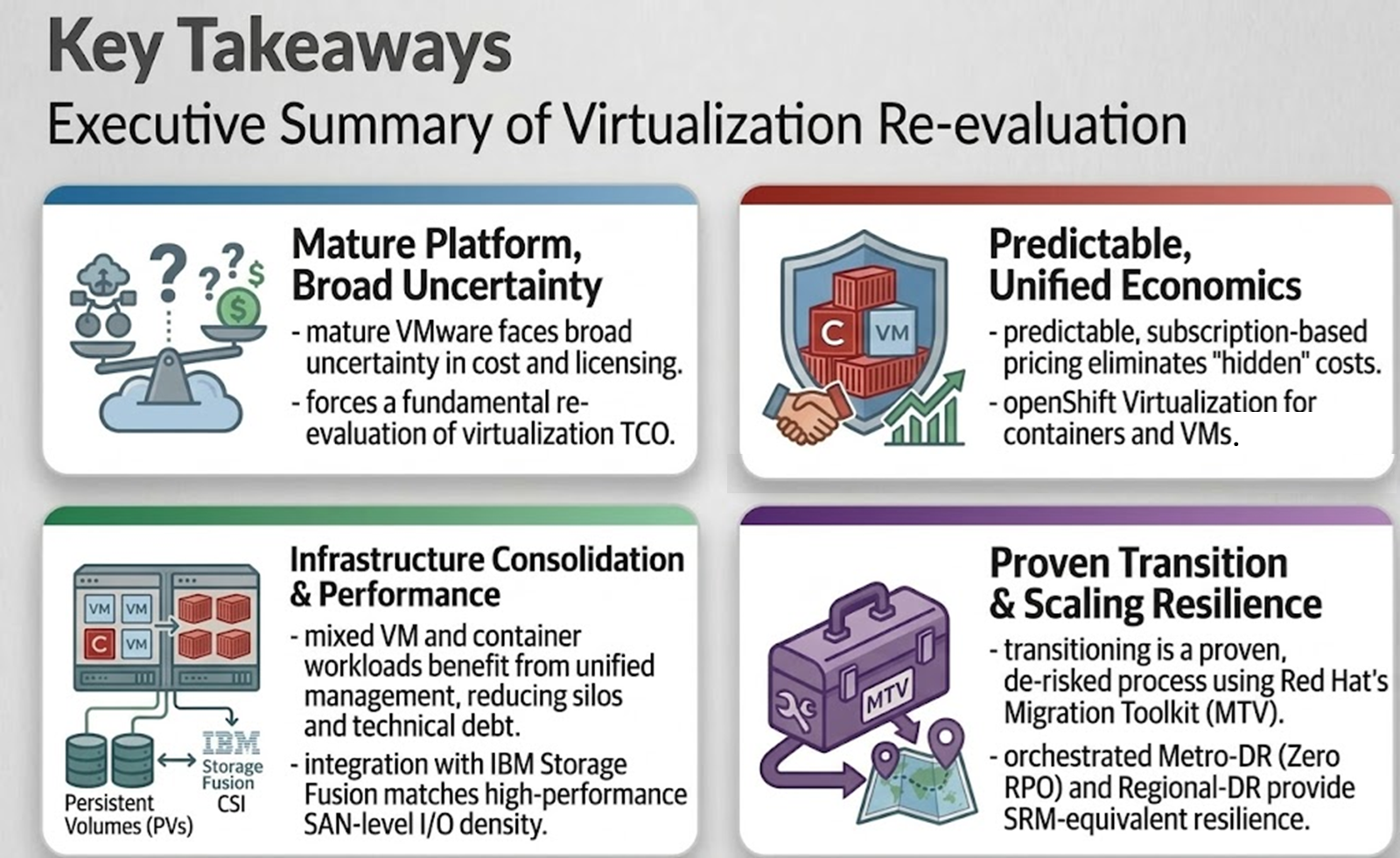
The enterprise virtualization landscape is undergoing its most significant transformation in over a decade. Broadcom's acquisition of VMware has triggered widespread concern among IT leaders, with licensing changes driving significant cost increases for many organizations. This seismic shift has accelerated interest in alternative platforms, with Red Hat OpenShift Virtualization, elevated by the enterprise-grade data services of IBM Storage Fusion, emerging as the leading enterprise-grade alternative for the modern data center.
According to Gartner, 35% of VMware workloads are expected to migrate to alternative platforms by 2028. For organizations evaluating their options, understanding the fundamental differences between OpenShift Virtualization and VMware, and how the IBM Storage Fusion ecosystem addresses critical operational gaps, is essential for making informed infrastructure decisions.
This comprehensive guide examines both platforms across every dimension that matters to enterprise IT: architecture, operations, networking, storage, high availability, disaster recovery, data protection, and the strategic path forward.
Understanding the Market Shift: Why Organizations Are Reconsidering VMware
Before diving into the technical comparison, it is essential to understand the market dynamics driving this evaluation for thousands of enterprises worldwide.
The Broadcom Factor
Broadcom's November 2023 acquisition of VMware fundamentally changed the virtualization market. The immediate impacts include:
- Elimination of perpetual licensing in favor of subscription-only models
- Consolidation of product bundles that force customers into high-tier suites (such as VMware Cloud Foundation)
- Termination of partner programs
These changes have prompted enterprise customers to evaluate alternatives more seriously than at any point in VMware's history.
Significant price increases have been reported, depending on the customer's previous licensing structure and deployment size. For the IT executive, this represents a transition from a predictable utility to a high-risk financial variable. These cost spikes are often accompanied by a reduction in support flexibility, leaving organizations paying more for a platform that may no longer fit their long-term architectural goals.
The Rise of Kubernetes-Native Virtualization
Simultaneously, the maturation of Kubernetes-native virtualization technologies has created a viable path forward. OpenShift Virtualization now offers enterprise-grade capabilities that enable organizations to run virtual machines alongside containers on a unified platform. This convergence addresses a long-standing challenge: managing heterogeneous workloads across separate infrastructure silos. However, the move to Kubernetes-native VMs requires a shift in how we think about the "Data Layer", a gap filled by the integration of IBM Storage Fusion.
Architecture Deep Dive: How Each Platform Works
Understanding the underlying mechanics is crucial for evaluating how each platform handles enterprise-scale workloads. While both platforms aim to run virtual workloads, the "under the hood" mechanics dictate how they scale, migrate, and recover.
VMware vSphere Architecture: The Proprietary Stack
VMware's virtualization stack centers on ESXi, a proprietary Type-1 (bare-metal) hypervisor. The VMkernel, a proprietary POSIX-like operating system, manages hardware abstraction and resource allocation. vCenter Server provides centralized management for multi-host environments, enabling features like vMotion (live migration), Distributed Resource Scheduler (DRS), and High Availability (HA).
In the VMware model, every virtual machine is a set of files (VMDK, VMX) residing on a datastore. The hypervisor is responsible for the entire lifecycle, and management is siloed within the vSphere client. This architecture has been refined over twenty years and offers comprehensive features for traditional workloads. However, the proprietary nature means organizations are dependent on Broadcom for all core functionality. Furthermore, ESXi is an isolated hypervisor; it does not "understand" containerized workloads natively, often requiring additional complex layers that add cost and operational friction.
OpenShift Virtualization Architecture: The Modern Engine
OpenShift Virtualization takes a fundamentally different approach by integrating virtualization into the Kubernetes orchestration platform. It does not attempt to "reinvent" the hypervisor but rather "wraps" a proven industry-standard hypervisor within a container-native framework.
- KVM (Kernel-based Virtual Machine): At its core, OpenShift leverages the Linux kernel's built-in Type-1 hypervisor. KVM is the industry standard for open-source virtualization, powering many of the world's largest public clouds (AWS, Google Cloud).
- KubeVirt: This is the core orchestration engine. It defines VMs as Custom Resource Definitions (CRDs). Instead of being a "file on a disk," a VM in OpenShift is a first-class citizen in the Kubernetes API.
- The virt-launcher Pod: Each VM runs inside a standard Kubernetes pod managed by the virt-launcher component. This means the VM inherits the same networking, security policies, and scheduling logic as a container.
If you have a security policy that governs a specific namespace, that policy applies to both the containers and the VMs within it.
IBM Storage Fusion: The Operational Fabric
While KubeVirt provides the engine, IBM Storage Fusion provides the enterprise-grade fabric. It integrates directly into the OpenShift control plane to provide Fusion Data Foundation (FDF), a software-defined storage layer built on Ceph that provides unified block, file, and object storage. This ensures that the virtualization environment has the same architectural stability and data resilience as a traditional SAN/vSphere setup.
Storage Integration: Persistent Volumes and Performance
One of the most significant shifts for VMware administrators is moving from Datastores to Persistent Volumes (PVs). In the VMware world, storage is defined by VMFS datastores. In the OpenShift world, storage is handled through the Kubernetes Persistent Volume framework.
The Lifecycle of a Virtual Disk
In OpenShift Virtualization, a VM's disk is represented as a Persistent Volume (PV). The process of provisioning storage is more dynamic and policy-driven:
- StorageClass: Administrators define different tiers of storage based on performance and resilience (e.g., "fast-block" vs "cold-storage").
- Persistent Volume Claim (PVC): When a user creates a VM, the system generates a PVC. This claim acts as a "ticket" that says, "I need a specific amount of storage from the fast-block tier."
- Binding: The cluster automatically binds that PVC to a PV provided by IBM Storage Fusion.
Fusion Data Foundation (FDF) and SAN Integration
IBM Storage Fusion optimizes this storage lifecycle. It supports FDF, which provides highly resilient block storage (Rados Block Device or RBD) for VM disks. This is critical for features like Live Migration. For a VM to move between nodes without downtime, the storage must be accessible to all nodes in the cluster simultaneously (ReadWriteMany or RWX). Fusion's FDF ensures that block storage can be mounted across multiple nodes, enabling seamless VM mobility.
Furthermore, Fusion supports External SAN (Fibre Channel/iSCSI) integration. This means your high-performance Tier-0 databases running in VMs can still leverage your existing enterprise SAN arrays while being managed natively through the OpenShift console. This allows a Fusion-managed environment to match the I/O density and performance of the most expensive VMware configurations.
High Availability and Disaster Recovery: The "SRM" Replacement
One of the greatest fears for organizations leaving VMware is the loss of Site Recovery Manager (SRM). While Kubernetes has native High Availability (restarting pods on healthy nodes), virtual machines require a higher level of orchestrated recovery to handle application dependencies and state. IBM Storage Fusion addresses this gap directly through integrated Disaster Recovery services.
Advanced DR Topologies
Fusion provides three primary patterns for Disaster Recovery that replace and extend VMware's traditional offerings:
- Metro-DR (Synchronous Replication): For sites located within metropolitan distances (<40ms latency), Fusion provides synchronous replication. This ensures a Zero RPO (zero data loss). If Site A fails, Site B takes over immediately with a 3-site tiebreaker to prevent split-brain scenarios. This is the direct replacement for vSphere Metro Storage Cluster (vMSC).
- Regional-DR (Asynchronous Replication): For long-distance recovery where latency is an issue, Fusion provides asynchronous replication with a predictable RPO of approximately 5 minutes. This includes Granular VM-Level DR, allowing administrators to fail over specific mission-critical applications rather than an entire namespace or site.
- Stretch Cluster: A single OpenShift cluster spread across two locations. Fusion Data Foundation natively mirrors the storage across both halves of the cluster, providing local HA with the simplicity of a single management plane.
Disaster Recovery (DR) Recipes: Replacing SRM Playbooks
VMware SRM uses recovery plans to dictate the order in which VMs start. IBM Storage Fusion provides an even more robust framework through DR Recipes. These recipes are YAML-based blueprints that define the entire recovery workflow.
- Orchestration: You can define a sequence where the database VM must reach a "healthy" state before the application server VM is allowed to boot.
- Hooks: Recipes support "hooks", custom scripts or commands that run at specific points in the recovery process.
- Parallel Hook Execution: A major advantage of the Fusion framework is the ability to run these hooks in parallel across the entire fleet. If you are failing over 50 VMs, Fusion can trigger the DNS update and IP reconfiguration hooks for all of them simultaneously, drastically reducing the Recovery Time Objective (RTO) compared to the serial execution found in traditional SRM workflows.
Data Protection: CBT and Ransomware Shield
Regardless of which platform you choose, data protection must be a central consideration. Enterprise Strategy Group research indicates that 89% of ransomware attacks specifically target backup repositories. This makes backup infrastructure one of the most critical, and vulnerable, components of any environment.
VMware Data Protection Ecosystem
VMware transitioned away from providing integrated backup solutions years ago, relying instead on a partner ecosystem through VADP (vStorage APIs for Data Protection). This relies on Changed Block Tracking (CBT), which identifies the specific blocks on a disk that have changed since the last backup.
IBM Storage Fusion Data Protection
IBM Storage Fusion brings this level of efficiency to the OpenShift environment through its natively integrated Backup and Recovery service.
- Changed Block Tracking (CBT) for Ceph RBD: Fusion tracks disk changes at the storage layer for Ceph-based block volumes. This allows for incremental-only backups. Instead of performing a "full" backup that scans the entire disk, Fusion only copies the "dirty" blocks. This matches VMware's efficiency, allowing multi-terabyte disks to be protected in minutes rather than hours.
- App-Consistent Snapshots: By integrating with the Windows Volume Shadow Copy Service (VSS) and the QEMU Guest Agent on Linux, Fusion "quiesces" the application (flushing memory buffers and pausing writes) before taking a snapshot. This ensures that restored databases boot cleanly without the risk of corruption.
- Immutable Storage: Fusion allows backups to be sent to S3 object stores with Object Lock enabled. This ensures that once a backup is written, it cannot be deleted or modified for a set period, providing a "bulletproof" defense against ransomware.
Migration from VMware to OpenShift Virtualization
For organizations considering a move, understanding the migration pathway is essential for risk assessment. Migration is no longer a "rip and replace" risk.
Migration Toolkit for Virtualization (MTV)
Red Hat provides the Migration Toolkit for Virtualization (MTV), which automates the mass migration of VMs from VMware vSphere to OpenShift. MTV connects directly to vCenter, discovers your VMs, and performs a "warm" or "cold" migration.
- Warm Migration: Copies the majority of the data while the VM is still running on VMware, performing a final sync and "cutover" that minimizes downtime to minutes.
- Cold Migration: Shuts down the VM and moves all data at once, ensuring the highest level of data consistency.
The Fusion Migration Advantage
When migrating into an OpenShift environment backed by IBM Storage Fusion, the "Day 2" transition is immediate. Once a VM is migrated by MTV, it is instantly recognized by Fusion as a protected resource. You can immediately assign it to a Metro-DR policy or a CBT-enabled backup schedule, ensuring that there is no "gap in protection" during the transition phase.
Conclusion: Making the Strategic Decision
The choice between VMware and OpenShift Virtualization is not simply about replacing one hypervisor with another. It is a strategic decision about the future of your organization's infrastructure.
VMware remains a capable, feature-rich platform with decades of refinement. However, the uncertainty introduced by Broadcom, particularly the reported cost increases and the forced bundling of products, has legitimately prompted organizations to seek stability elsewhere.
OpenShift Virtualization, combined with the advanced data services of IBM Storage Fusion, offers a compelling, no-compromise path forward. By providing DR Recipes for orchestrated recovery, CBT for high-performance backups, and native Persistent Volume (PV) management, IBM and Red Hat have built a stack that matches VMware's enterprise resilience while offering the agility, transparency, and cost-predictability of a cloud-native future.
The transition to a unified platform for VMs and containers is not just a way to save on licensing costs; it is a way to modernize operations, reduce technical debt, and prepare your infrastructure for the next decade of innovation.
Next Steps
If your organization is evaluating alternatives to VMware, here is a recommended path forward:
- Run Li9's VMware discovery script. Li9 has developed a lightweight script that you can run against your VMware environment to determine its exact size, complexity, and licensing costs. The output gives us everything we need to deliver precise pricing for both infrastructure and migration services tailored to your specific environment, with no guesswork involved.
- Run a proof of concept. Deploy OpenShift Virtualization in a lab environment with IBM Storage Fusion. Migrate a handful of non-critical VMs using MTV and test live migration, backup, and DR workflows firsthand.
- Engage Li9 for a migration plan. Our certified Red Hat and IBM architects have guided dozens of enterprises through VMware-to-OpenShift migrations. We will help you build a phased migration plan, compare your current VMware TCO against the OpenShift subscription model, and chart a path tailored to your environment and risk tolerance.
Ready to Evaluate Your VMware Alternative?
Li9 specializes in OpenShift Virtualization migrations backed by IBM Storage Fusion. Let our certified architects help you build a migration strategy tailored to your environment.
Schedule a Consultation